

Nutrition Basics for Ultrarunners
Unlike marathons and shorter duration events, being prepared for an ultramarathon doesn't simply mean completing your training plan. Perhaps the biggest difference is nutrition.
With some basic carb-loading and a haphazard nutrition plan, many marathoners can get through an event without depleting their glycogen (carbohydrate) stores (although many don't). However, that is almost impossible in an ultra! Most trained runners will have approximately 90-120mins of glycogen stores in their muscles and liver ready for use. With most ultramarathons taking 5 hours or more, we NEED to have a solid nutrition plan to have any hope of a good performance.
Sources of Fuel
Lets start off with some basics!
All cells in our body require a substance called adenosine triphosphate (ATP) for energy. To maintain bodily functions and to facilitate survival (think fight or flight!) our body maintains a very small amount of ATP at all times - enough for around 8-10 seconds of intensity activity.
Once that is exhausted we have a number of mechanisms which produce more ATP, depending on the urgency. In very simple terms, there are two main methods:
Oxidation of fats - fatty acids are broken down to (eventually) create ATP. Even slim runners have a very large amount of fat available for use as energy within their bodies, however oxidation of fat is a relatively slow process. Think of it as a large fuel tank with a small pump.
Oxidation of carbohydrates - glycogen and glucose are broken down very quickly to create ATP. Whilst this process happens quite quickly, there is a limited supply. Think of its as a small fuel tank with a large pump.

At low intensities, our cells utilise fat oxidation as the primary source of energy. As the intensity increase, our body transitions to using carbohydrates as its a much faster process. Fortunately for us, endurance training is an effective tool for making both of these systems for economical, especially the fat oxidation cycle. Because we generally spend most of our time training at low intensities, our bodies become very effective at using fat for fuel. The difference between trained and un-trained runners can be seen below.

However, as you can see from the images above, even trained runners are using glycogen and depleting their stores at low intensities. Therefore effective management of glycogen is required for optimal performance!
Pre-Race Nutrition
In the days leading up to a race, increasing carbohydrate consumption can increase glycogen stores slightly above their 'normal' levels. This is known as carb-loading and is a well established practice in marathons and ultramarathons.
By topping up glycogen stored in the muscles and liver you'll prolong the time until those stores runout.
HOWEVER, carb loading is often misunderstood and executed incorrectly. This results in bloating, gastro-intestinal (GI) discomfort and problems with getting in race nutrition. Carbohydrate needs to be gradually increased and REPLACE other macronutrients rather than be ADDED to the diet.

For ultramarathons where getting in higher levels of race nutrition is essential, not overdoing the carb load is even more important. We'll be delving into a specific protocol for ultramarathon carb loading with a separate article very soon!
During Race Nutrition
As we've established, we need to consume carbohydrates during our events to top up our glycogen stores. We've all heard and seen those athletes than are claiming they're consuming 120 - 180 grams of carbohydrate per hour (g/hr), but that simply isn't going to be achievable for the vast majority of runners. Nor is it necessary.
A good place to start is 50-60g/hr as that's super simple to calculate and most people can tolerate it immediately with out any practice. 60g/hr is essentially two gels per hour or two heaped scoops of most nutrition drinks (e.g. Tailwind or Skratch). Ideally the goal would be to consume up to 80-90g/hr if tolerable.
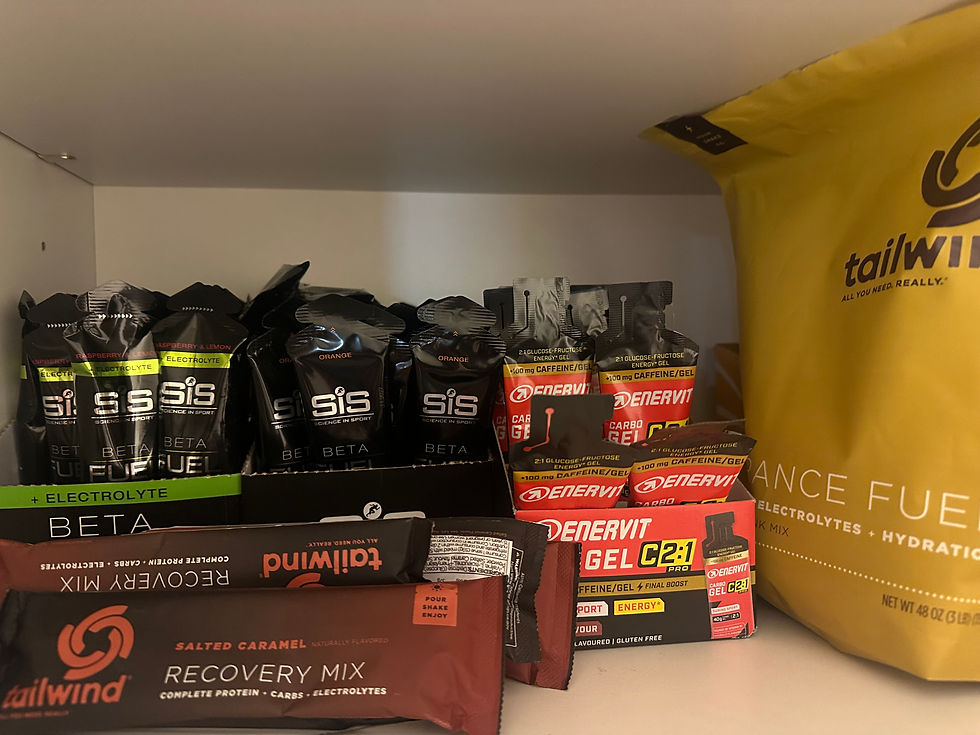
The difficult part of this is working out which products at which rates work for you as an individual. What works for one runner will probably not work for the next. Therefore its extremely important to practice this in training (see Training Your Gut section below).
Training your Gut
As we've said, you want to be able to consume as many carbohydrates as possible without causing GI issues. Most people can't jump straight to 80-90g/hr without starting lower and working their way up.
Fortunately, the stomach adapts really quickly to increased consumption. If you were to have 80g/hr and found it to be a little too much, there's a good chance that within the next 1-2 weeks (and the same conditions), that same 80g/hr would be tolerable.
Therefore we recommend our athletes all practice their race nutrition EVERY long run! Not only does it help in being able to tolerate higher amounts, it also gives you a chance to try a range of products and find out how they work in different conditions (hot vs cold vs humid). Practicing every week also makes it become second nature, just like putting one foot in front of the other!
Post Race Nutrition
Nutrition doesn't stop once you stop running. Recovery nutrition is important to ensure glycogen stores are replenished and that your muscles have sufficient protein available to repair the damage you've just inflicted on them!
Recovery nutrition should include a combination of carbohydrates, protein and fluids. The ideal ratio for carbohydrates to protein is 2:1 (e.g. 20g of carbohydrates and 10g of protein). Somewhat fortuitously, chocolate milk is naturally pretty close to this ratio! But there are also plenty of specialised products available that have been designed to meet these requirements (again, Tailwind and Skratch are good examples).

The timing of recovery nutrition is also pretty important. In the 30-60mins post-exercise, our bodies are naturally primed to absorb these proteins and carbohydrates and direct them straight to the areas that need them. If you can't meet this timeframe, it's still important to follow the same protocol, it'll just take a little longer to be effective. Therefore, having a shaker or something in your car, your drop bag or with your crew is important.
There is no 'Perfect' Nutrition Plan
This article is intended to be a brief introduction and explanation into nutrition. As we've eluded to, nutrition is different for everyone. But even more than that, it can be different for the same runner in different environmental conditions, at different intensities and even at different altitudes.
Practicing nutrition before your race or event is just as important as getting the miles done. This will allow you to individualise your race nutrition plan to what works. The key factors to consider when preparing your race plan include:
Race duration (consider flavour fatigue and will you need solid foods at some point?).
Race intensity (and how it varies throughout the race - think long downhills vs long uphills)
Weather (including how the weather will vary throughout long events)
Aid station access (do they have your preferred products or will you have to carry them / put them in a drop bag).
The goal is to be practicing this constantly during training. You wouldn't turn up to a race with a brand new type of shoe or pack (hopefully?), so don't do it with your nutrition!


Comments